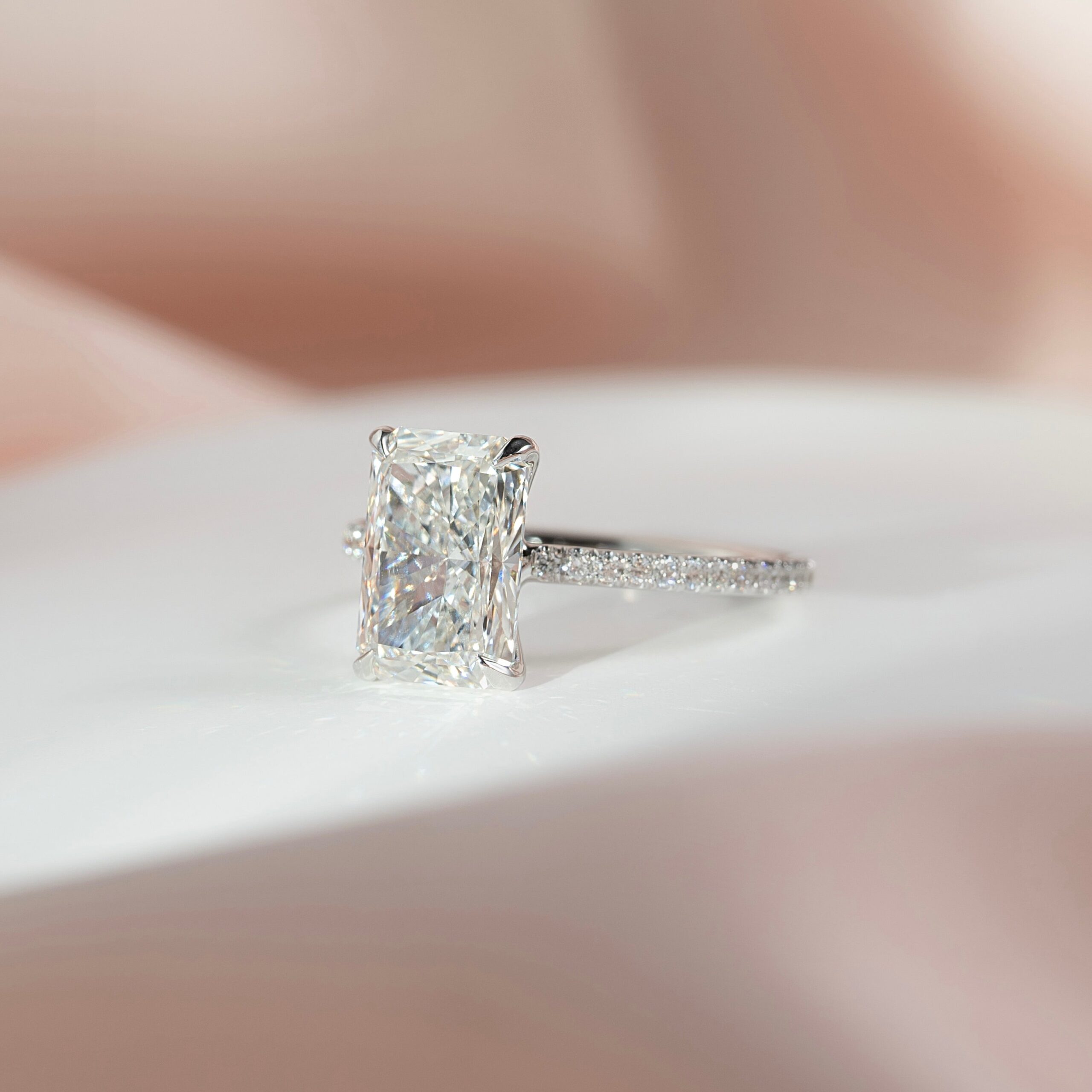
The journey toward finding the perfect engagement ring represents one of life’s most meaningful quests—a search for the tangible symbol that will represent your commitment for decades to come. Among the various diamond cuts available today, the radiant cut offers a distinctive combination of fire, brilliance, and geometric precision that appeals to those seeking something simultaneously unique and timeless. Learning how to discover radiant cut engagement rings that truly sparkle requires understanding both technical diamond characteristics and aesthetic considerations that influence this captivating cut. This comprehensive guide walks you through the essential steps in finding a radiant cut ring with exceptional light performance, helping you navigate the complex world of diamond selection with confidence and clarity.
Mastering the Anatomy of Radiant Cut Brilliance
The radiant cut’s distinctive sparkle derives from its unique faceting pattern—typically 70 facets arranged to maximize light return through the crown. Unlike brilliant rounds that prioritize sparkle above all else or step-cut emeralds that emphasize clarity and geometric lines, radiants achieve a remarkable balance between these competing priorities.
When evaluating a radiant’s sparkle potential, examine how light behaves across the diamond’s surface under various lighting conditions. Superior radiants display consistent brightness across the entire stone without dark or dead zones, particularly in the center. This uniform light distribution indicates optimal facet arrangement and proper cutting angles.
Pay special attention to the diamond’s table percentage—the ratio of the largest facet’s width to the overall stone width. Ideal radiants typically feature table percentages between 61-69%. Tables outside this range often compromise light performance, either limiting internal reflection or creating disproportionate faceting that diminishes sparkle.
The pavilion depth fundamentally influences light behavior within the stone. Too shallow pavilions leak light through the bottom, while excessively deep ones appear dark or create unwanted color concentrations. Expert cutters balance these factors precisely, achieving maximum brilliance through mathematical precision rather than arbitrary proportioning.
Evaluating the Four Cs for Radiant Cuts
While the standard four Cs (cut, color, clarity, carat) apply to all diamonds, their relative importance shifts somewhat for radiant cuts:
The cut quality, though not officially graded for radiants by GIA, remains paramount. Since no standardized ideal proportions exist for radiants, visual assessment becomes crucial. Observe how the diamond handles light in different environments—stores, natural daylight, and dim settings. Superior radiants maintain exceptional brilliance across these varying conditions.
Color considerations require careful attention with radiants, as their faceting pattern tends to retain color more visibly than some other cuts. For white diamonds, staying within the G-H range typically offers the best value proposition, appearing colorless to the naked eye while avoiding the premium pricing of D-F grades. For fancy colored diamonds, radiants excel at color amplification, making them excellent choices for yellow, pink, or blue stones.
Clarity requirements prove more forgiving in radiants compared to step cuts like emeralds. The numerous facets effectively disguise minor inclusions, making VS2-SI1 clarity grades often indistinguishable from higher grades to the unaided eye. Focus on inclusions that might impact structural integrity or appear in the center table where they’re most visible.
Carat weight interacts uniquely with radiants, which typically appear 15-20% smaller than round brilliants of equivalent weight due to their geometric proportions. This visual characteristic means selecting slightly higher carat weights than you might with other cuts to achieve comparable visual impact.
Selecting Complementary Settings and Designs
The setting significantly influences how a radiant’s sparkle manifests in the finished ring. Several design considerations particularly enhance radiant performance:
Four-prong settings maximize light exposure while securing vulnerable corners. This minimal metal approach allows maximum brilliance expression while maintaining structural integrity. For rectangular radiants, consider V-shaped prongs that protect corners while contouring elegantly to the diamond’s shape.